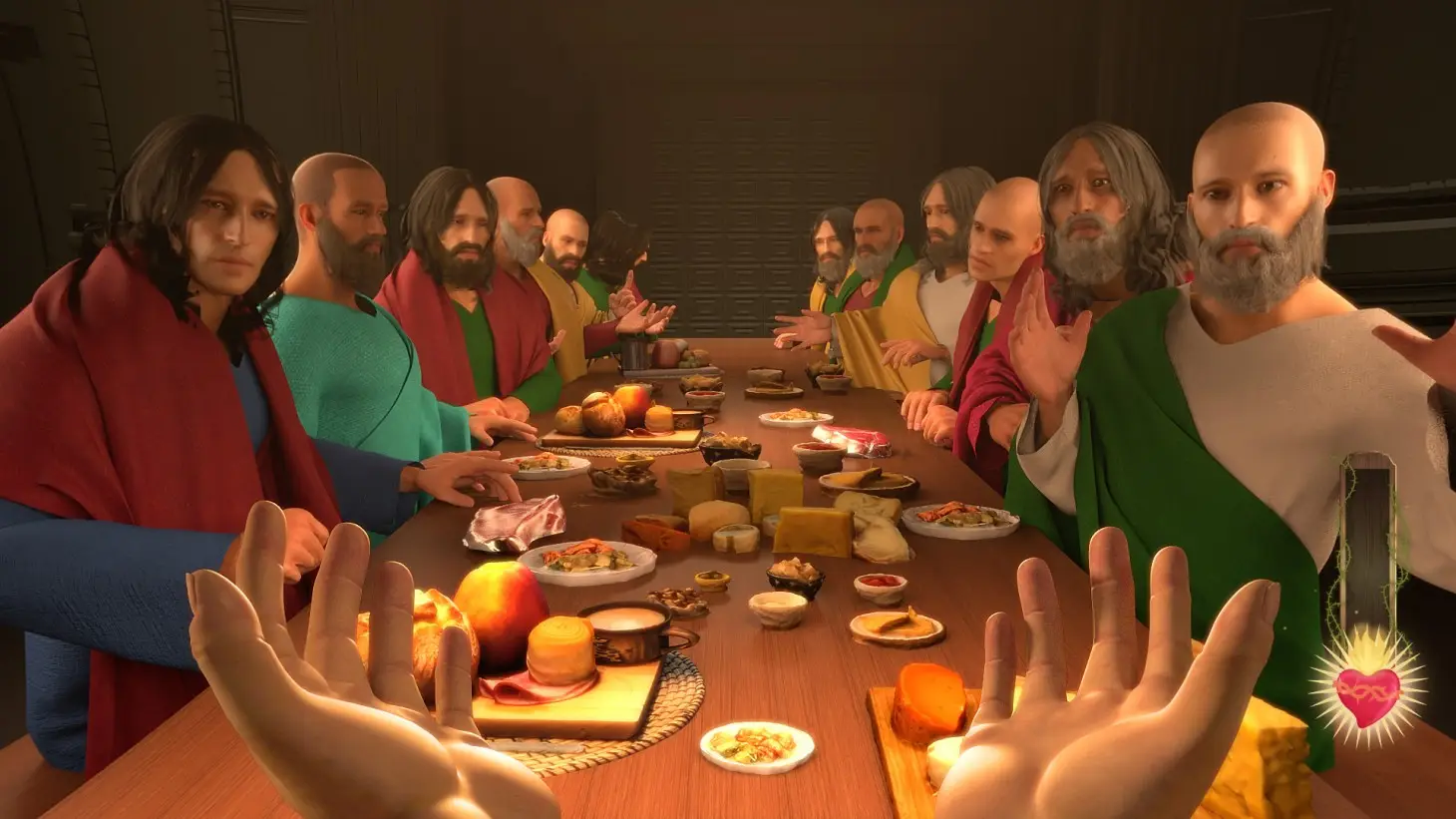

Players must travel through the Holy Land, gather the apostles, deliver speeches, and create miracles, such as turning water into wine or exorcising demons. The game culminates in resurrection, but the developers have made these scenes more symbolic to avoid unnecessary violence.
On Steam, the game has received unexpectedly high ratings, with around 86% of reviews being positive.
When I first heard about this project, I thought it would be some kind of humorous trash game created just for memes, but the developers have taken the subject very seriously, with no intention of mocking anyone.
In your tour journey, you’ll see the deserts, mountains, and small towns of that era. Visually, everything looks simple: the textures are basic, the character animations are slightly awkward, and the controls aren’t the best either. Basically, you walk around, interact with characters, and complete quests. Most of the miracles are designed as mini-games; for example, you have to press buttons at the right time or move the cursor to guide a fish into a boat. To perform these actions, you use a resource called Faith, which can be restored during prayer.
Steam players have a lot of good things to say about this simulator. People who believe in God say the game helps them visualize biblical stories better. They praise the game for its accuracy in recreating the stories and for the strong emotions it evokes, particularly in the prayer scenes in the Garden of Gethsemane. Many note that it is an excellent interactive textbook that could be used in religious education lessons for children. However, even in positive reviews, people criticize the artificial-intelligence-generated voice acting, which sounds a bit unnatural, and the repetitive gameplay. Essentially, it is a walking simulator with simple tasks that repeat quickly.
For me, religious themes are part of world culture and literature. From this perspective, the game struck me as an interesting experiment. Instead of reading dry text, you feel as though you are a participant in a great historical drama. I was curious to see exactly how the developers would tackle such complex themes in a computer game format.
But if you set aside the religious context and judge the game mechanics on their own merits, ‘I Am Jesus Christ’ has serious issues. There is sometimes a stark contrast between the gravity of the subject matter and how it is executed. For example, when a majestic miracle turns into rapid button-mashing, it feels too childish and simplistic. The characters’ artificial voices often spoil the atmosphere, as they sound emotionless. The character models themselves are often repetitive, making it feel as though you’re talking to the same townspeople all the time. The most entertaining activity for many players, myself included, was running and jumping across barrels and rooftops, which looked rather comical for such a character.
Overall, the game leaves a mixed but largely positive impression thanks to its boldness. It’s certainly not perfect, technically simple, and can be completed in just 5–6 hours.
Average
| CPU | Ryzen 5 3600 |
| RAM | 16gb |
| GPU | RTX 2080 |
Disclosure: review copy of I Am Jesus Christ was provided by Keymailer for evaluation purposes.